“This article explores pickleball’s journey from a 1965 backyard invention to a modern Los Angeles phenomenon. It covers the sport’s quirky origins, technical evolution, and the booming demand for local indoor and outdoor courts in today’s high energy social scene.”
It was the summer of 1965 on Bainbridge Island, just a short ferry ride from Seattle. Three fathers Joel Pritchard, Bill Bell and Barney McCallum were staring at a group of bored children who had officially exhausted every summer activity they could think of. They had a badminton court but no shuttlecock. They had some old ping pong paddles and a perforated plastic ball.
In pure dad engineering, they lowered the badminton net to 36 inches, hit the ball over it, and accidentally created a phenomenon. They were trying to survive a Saturday afternoon without saying I’m bored, not changing sports.
What started as improvised backyard distraction has, decades later, exploded into legitimate cultural movement. Nowhere is more obvious than in frantic search for pickleball courts in Los Angeles. The game has migrated from the rainy Pacific Northwest to the sun drenched concrete of Southern California, turning a simple backyard hobby into a high stakes urban obsession.
The Pickle Boat and Plywood Paddles
The complex history of pickleball’s name is one of the most human things about it. If you ask a casual player, they might say that the sport got its name from the Pritchards’ dog, Pickles. The plot is nice, but the timeframe points to a different reality. Joan Pritchard came up with the term after the pickle boat in rowing, which is a boat that is filled with leftover oarsmen from earlier crews. The name complemented the leftover theme wonderfully because the game was a mix of tennis, badminton and ping pong. The family did not even get the dog until two years after the game was named, which is funny.
From Retirement Homes to Hollywood
For decades, pickleball carried a bit of a senior sport stigma. It was largely seen as something played at retirement communities in Florida or Arizona. However, the 1980s changed the game’s trajectory. The formation of the USAPA in 1984 brought a standardized rulebook and Boeing industrial engineer Arlen Paranto used airplane flooring materials to create the first composite paddle. Suddenly, the ball moved faster, the spin was tighter and the sport gained a competitive edge.
Then came the 2020 lockdowns. When gyms closed, people flooded local parks looking for safe ways to stay active. In a city like LA, where social status is often tied to the next big thing, pickleball became the ultimate pandemic pivot. Today, pickleball Los Angeles is a full blown lifestyle. Its rapid rise has been driven by accessibility, celebrity adoption and community culture, making pickleball one of the fastest growing recreational sports across Los Angeles.
Finding Your Spot: The LA Court Scarcity
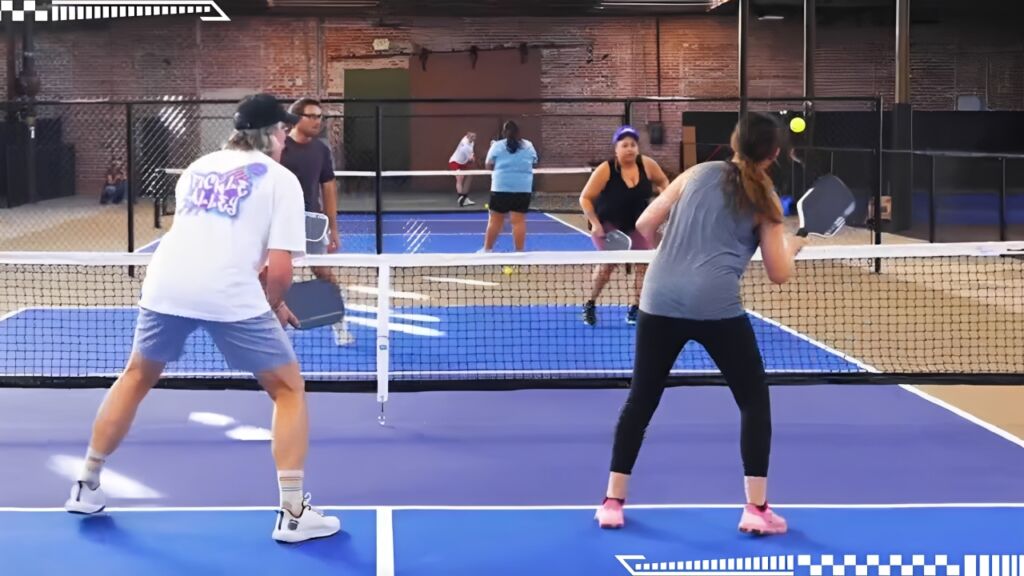
If you are ever tried to grab a game in the city, you know the struggle. The hunt for pickleball courts in Los Angeles has turned into a competitive sport of its own. Because urban space is at such a premium, the community has had to get creative.
- The Outdoor Hustle: Public parks like Riverside in Los Feliz or courts in Santa Monica are legendary for paddle in the rack systems. You show up, put your paddle in line and wait. It is the ultimate social mixer you might play with a college student one round and a retired film producer the next
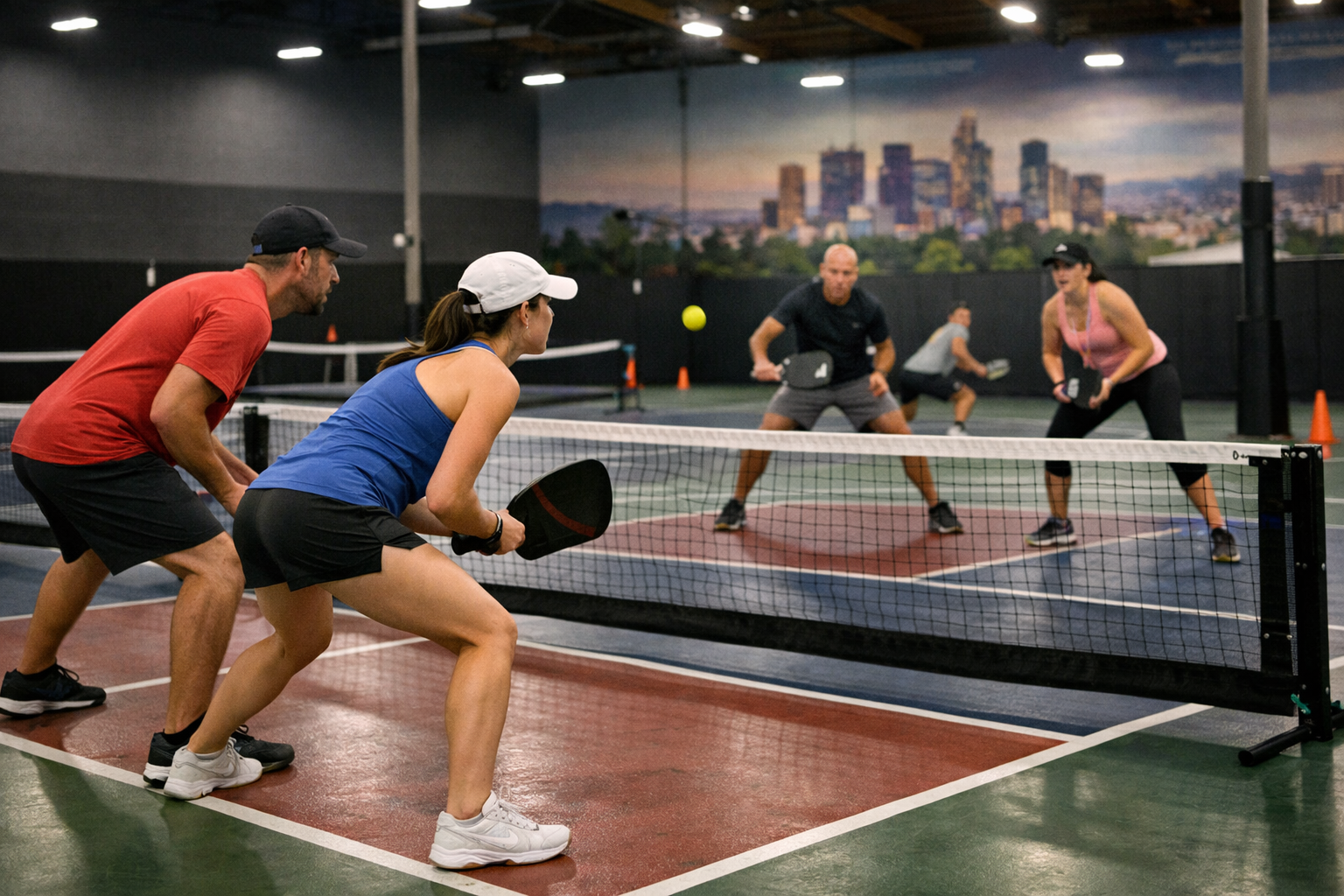
- The Indoor Revolution: Because of the dense population and the Southern California heat, the demand for indoor pickleball Los Angeles has skyrocketed. Players increasingly seek a country club experience without the sun damage. In renovated warehouses and disused retail spaces, these facilities offer air conditioning, social areas and courts that may be reserved in advance to prevent long lines
Why It Is Actually Addictive
Why are we so obsessed? It’s not just the exercise; it’s the geometry of the game, specifically the Kitchen.
The Non Volley Zone the Kitchen is the seven foot area near the net where you are not allowed to hit the ball out of the air. This rule forces a dink game, a soft, strategic back and forth that requires players to stand only 14 feet apart. It is the only sport where you can actually have a full conversation with your opponent while playing at a high level. It is social by design, which is a rare and valuable thing in a world dominated by digital screens.
The Professional Horizon
We are currently living through the Gold Rush era of the sport. Professional leagues like Major League Pickleball are turning players into household names and the push for the Olympics is stronger than ever. In Los Angeles, the scene is a blend of high end private clubs and gritty public park culture. It is city where you can see pro practicing on the court next to group of friends just trying to keep the ball in play.
Conclusion
Looking back at that 1965 afternoon on Bainbridge Island, it is incredible to see how far those plywood paddles have traveled. Pickleball did not succeed because it was sophisticated it succeeded. After all it was inclusive. It took the best parts of three different sports and stripped away the ego.
Whether you are a regular at the outdoor pickleball courts in Encino or you are just now looking for your first pair of court shoes you are part of a legacy that started with a bored family and a pickle boat philosophy. The game is here to stay and in a city as fast-paced as Los Angeles, perhaps a game built on dinking and conversation is exactly what we needed.